
This is an old revision of the document!
Table of Contents
This page is part of a series on
Systems

Systems
Emotions Engine
Comms Engine
Direct Engine
Core
TRANSCOM
ULTRACOMFY Ethical Jurisdiction System
Mechanics
Interceptions and Encounters
Claim
Social Jurisdiction
Other
Statistical Inevitability
Malus Necessarium
Conversation Difficulty
50%
Probably Wrong
Traits
Apology
Psychology/Human Behavior/Social Behavior/Conflict/Conflict Resolution/
Apology
Humans make mistakes. Sometimes, humans make really big mistakes. When a human makes mistakes, it can lead to severe physical or emotional damage to people around them. Such mistakes create social disharmony and break the trust in that person's willingness to maintain social harmony. Unfortunately as humans, the experience of being wronged by others is something we have to accept, no matter how severe the pain we were inflicted. Holding onto the pain and holding onto this social disharmony does not do anyone any good. The only way us humans have to move forward is through forgiveness. However, forgiveness can only come on the condition that the offender shows remorse, regret and a sincere commitment to maintain social harmony in the future.
While there are many ways to express remorse, regret and a sincere commitment to maintaining social harmony, the classical approach for speaking humans is what we call an apology. In its simplest terms, an apology is an explicit expression of these feelings (ie. a “formal display”), either in spoken or written form. Strategically, from the perspective of the offender, the goal of an apology is to convince others that they are genuinely feeling remorse, regret and are committed to maintaining social harmony in the future. A really heartfelt apology will have the emotional goal to also alleviate some of that remorse, in the hope that expressing one's regret makes the victims feel better.
Strategical Considerations
For an apology to be effective in expressing an intent to restore social harmony, it must show a genuine insight in the damage that was caused by the offender. This involves the offender laying out what he did and what damage his actions caused. Without this insight, an offender could not make a valuable apology. The classical interpretation of this leads to a standard apology template that looks like this:
- The offender is, in some way, responsible for the unjust actions taken
- The offender is aware of the injustices that resulted from those actions
- The offender intends to behave differently in the future
See Wikipedia: Apology (act)#Elements
Since the goal of an apology is to express remorse or regret, an apology should not spend time talking about the offender's motivations or justifications. Talking about the offender's actions, rather than the damage caused, is also a good indicator for sincerity. While anyone can be “sorry” for a missing leg, only the offender can be sorry for their actions that lead you to lose your leg.
Expressing Sympathy
In some circles, apology-like expressions may be used as a means to express sympathy for a person who has been wronged or is otherwise going through a difficult time. Individuals may say that they are “sorry” for someone who just lost their husband, even though they were not involved in the husband's fate. In my understanding, this is not an apology as in my formal understanding of what really is an apology, but is conceptually a valid strategy to express sympathy for a person as a means of emotional support.
Over-Apologization
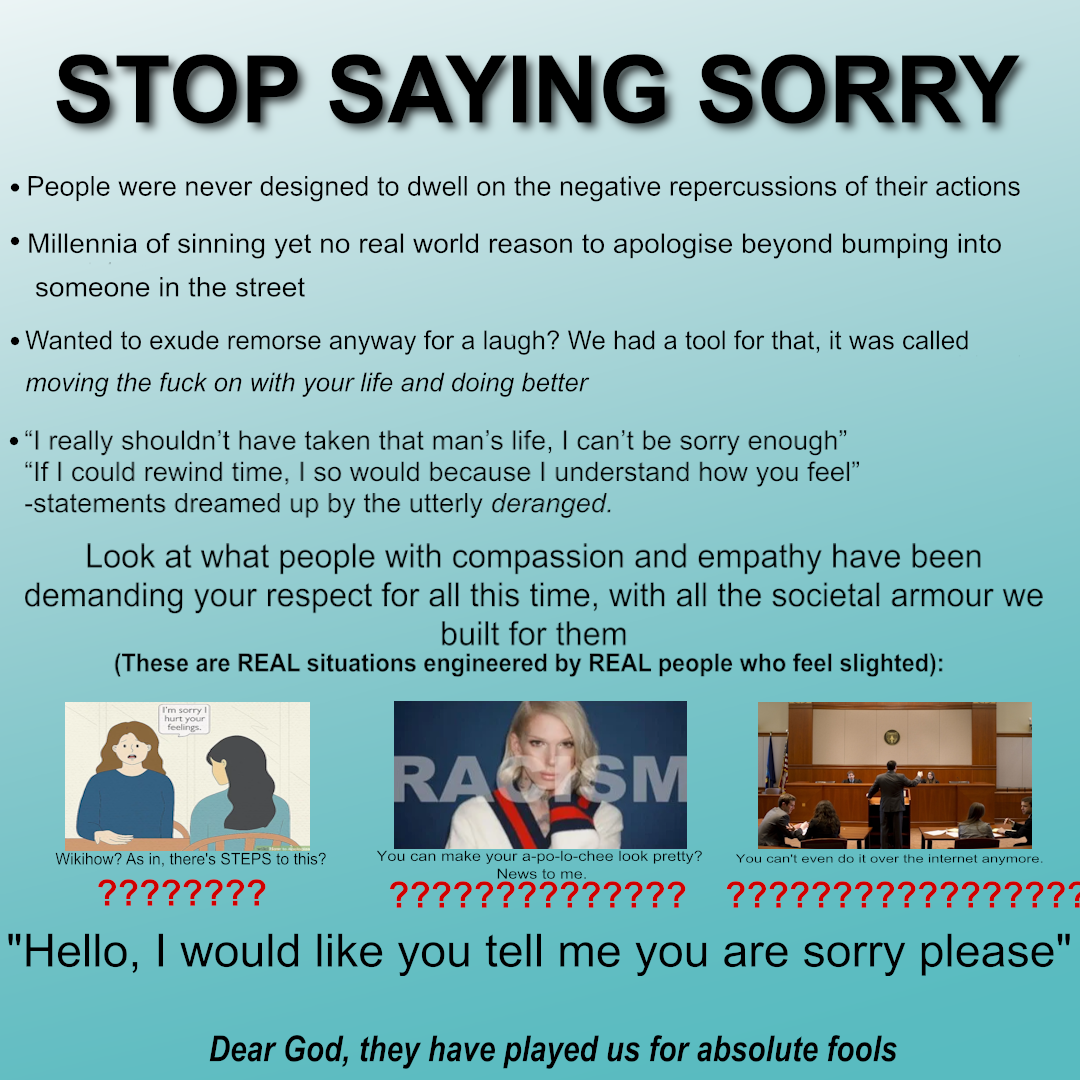
“Wanted to exude remorse anyway for a laugh? We had a tool for that, it was called moving the fuck on with your life and doing better.” - Why do I even write pages when I could just post intelligent pictures instead?
Another phenomenon with apologies is people who cannot help themselves from constantly apologizing over every minute thing that, if it does not cause an inconvenience, at least had the potential to cause an inconvenience. The classic response to being told to please stop is an apology for the constant apologizing. The type to over-apologize is typically one that is very insecure and extremely paranoid about what others think about them, often even to the point where they would still rather apologize even if they're told that their apologies are much worse than not saying anything. It is probably a learned response from a time (often with parents?) in which even the slightest missteps would set people off, so they would learn to pre-empt that by using apologization as an appeasement strategy. I don't like over-apologization for three primary reasons:
First, I don't like this because I do not need to be appeased. Being treated as such anyway conveys a sense that they believe, intentional or not, that I cannot control my temper and will lash out at people for slight missteps. My emotions are more complex than simple appeasement strategies and attempts at appeasing me make me feel infantilized.
Secondly, Additionally, apologies require a level of sincerity. By constantly issuing apologies, it becomes harder and harder for me to believe in an individual's sincerity. The more a person apologizes, the more I will start asking myself “Okay, why don't you just start changing your ways then?” and their apologies become harder to believe, up to a point where I have to concede that their apologies are probably mostly a formality. And, well, as an appeasement strategy, these apologies are a formality, but then these apologies should better not be used at all. There is no value in an apology used exclusively as a formality. And regardless of whether an apology is used exclusively strategically, or it is really an honest expression of regret, it does not matter when they happen constantly and begin to blend into each other. At some point they become a formality, either way. I think that apologies should be used sparingly, and that each apology in succession incrementally takes away from the next.
Thirdly, individuals with self-worth problems often know that they have them. Now, while thought patterns are very hard to dislodge and often need professional support, reflecting on one's behavior and making an active effort to change it is a very reasonably achievable undertaking.
If someone is psychologically ill, their goal is most likely to get better. Stopping over-apologization in settings where it is inappropriate is a very easy way of actively making an effort towards improving.
Of course, recognizing behavioral patterns, stopping them as you do them and replacing them with others is still an immense conscious effort that takes a long time and should ideally happen in a therapist-assisted setting. When I say it is a “very easy way”, I mean that in comparison to other methods typically explored in therapy. In absolute terms it is still very hard though, of course. Either way, a person who is told that they shouldn't over-apologize needs to realize that stopping is indeed the right way, even if they are perhaps unable to change their behavior at that moment. However, It is very suspicious if a person resists that realization (that stopping is the right thing to do), or even actively finds justifications for their current behavior. These indicate to me that the person is not really interested in actually doing something about their situation.
Apologies in my System
As you will perhaps be able to preticipate, I have systematized the process of giving out apologies. In fact, I call it “issuing” apologies. However, even though it is systematized, and even though I do calculate thresholds for issuing apologies, much of the system resembles what would be going on in anyone else's brain regarding apologies.
But, one clear difference is the rather strict limitations around the definition of an apology. For me, an apology is something I do explicitly as an expression of remorse, and only remorse. I do not say sorry for things that were not my fault. Using the methods of an apology to simply and only express sympathy towards another person is considered a wrongful use of the apology system. That's not a crime or wrongdoing, but it's a formal mistake that can lead to confusion, as people who don't reflect on these differences that much may get them confused, which can lead to drama. It also makes future dissemination more difficult for that person, as they will have to unlearn years of “doing it wrong”.
Personally, I still express sympathy for people in such situations, but I do not use the apology framework to make that happen.
Structurally, for me to issue a proper apology requires me to accept that I did indeed do something unjust. Calculating the justness of my actions is one of the many reasons for why I constantly evaluate and re-evaluate my actions. When I find that I did something unjust and, as a consequence, hurt another person, I will issue an apology automatically. This constantly happens and they are sincere apologies.
However, in many cases it can happen that I and another person disagree over whether what I did was unjust. The important difference here is that I can do things that can lead to hurt in other people, but that does not mean that it is necessarily unjust. In these cases, I will not be issuing an apology, but invite damaged individuals to make the case that what I did was indeed unjust. It is possible to reach out to me via the complaint form and specifically request an apology, as a request for revision, so that I double check that what I did really was (or wasn't) just.
In some cases, individuals may be requesting an apology purely because it would make them feel better, even if they know that what happened was not unjust. These requests are generally denied, but I am willing to compromise just a little bit if I am already close to the threshold of issuing an apology. Of course, these apologies are closer to an expression of sympathy rather than a real apology. I don't know why humans would want me to issue an apology over that anyway. Humans are weird.